
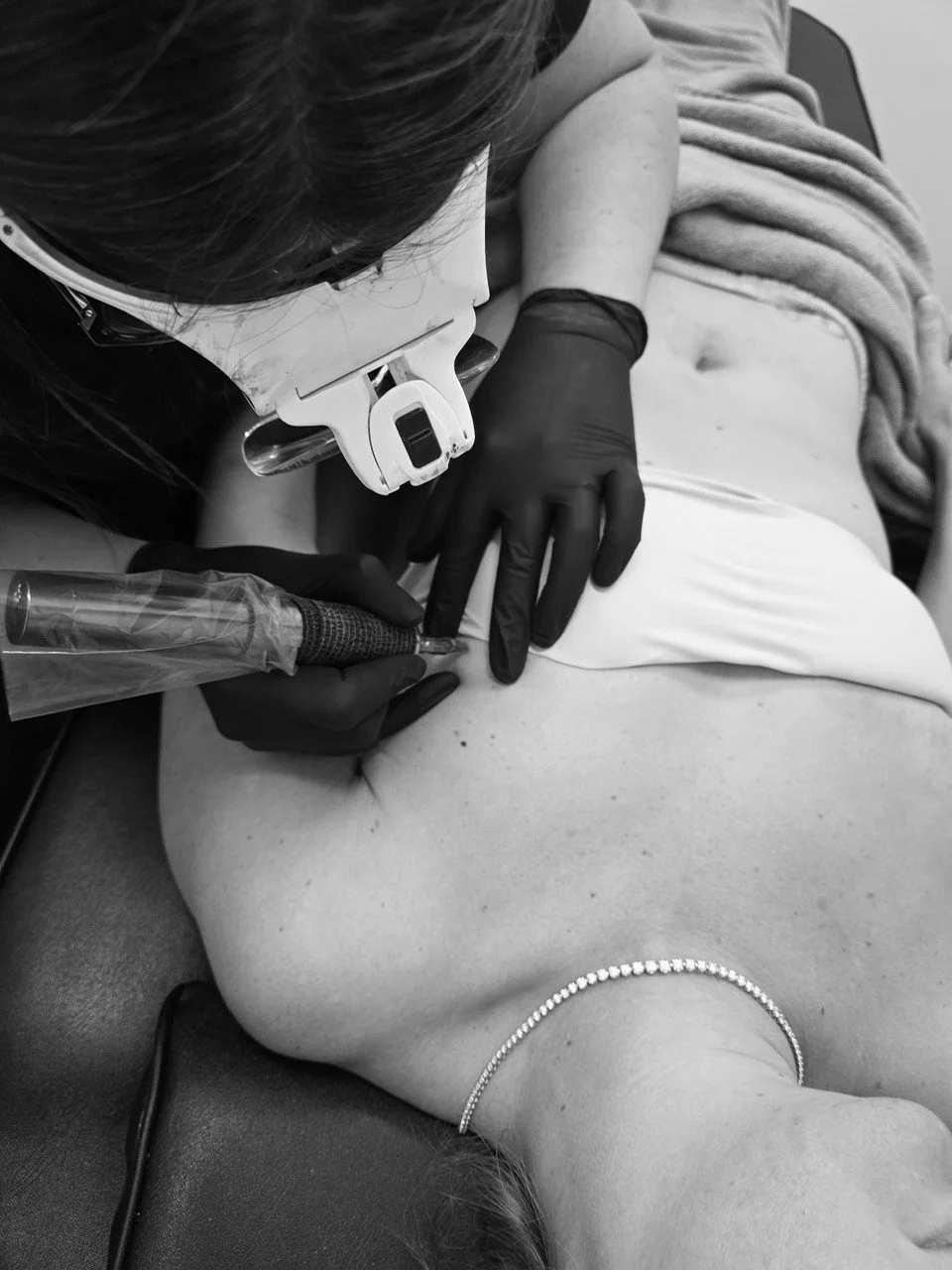
Making an informed decision is important when it comes to you or your family member. Listed below are some commonly asked questions.
Frequently
✳︎
Asked
✳︎
Questions
✳︎
Frequently ✳︎ Asked ✳︎ Questions ✳︎
What does our Integumentary (skin) system include?
Three layers of skin;
1) Epidermis - The outermost layer that is constantly renewing itself as old dead skin cells shed and new cells are formed.
2) Dermis - Located just below the epidermis consisting of your collagen, blood vessels and elastin fibers. THE IDEAL LAYER TO INSERT TATTOO PIGMENTS OR SERUMS. Reason being, this layer is stable and can retain colour for years, also the home for fibroblast stimulation which will kickstart your collagen and elastin fibers that may be sitting dormant due to trauma from surgery, excessive stretching or burns.
3) Hypodermis - The deepest layer. This layer is composted of your fat and connective tissue which helps regulate your body’s temperature and enable sensation.
What are the contraindications for use of ISR treatment?
Cannot be pregnant.
Diabetic (on sliding scale or needle).
Infectious skin conditions such as psoriasis, impetigo and cellulitis.
Scars that are less than 12 months.
Keloid scarring.
NO use of Aquaphor ointment for 12 months.
What is Inkless scar stretchmark revision?
Using a rotary pen to inject serums containing hydration agents, mixed vitamins, amino acids at the dermis level that will target collagen and elastin fibers. A rotary pen is considered very pinpoint focused to target scar tissue only, not the surrounding healthy tissue. Safe for all skin tones because it is stimulating the natural melanin production. There is no pigment (Ink) in this treatment. Inkless is considered completely natural.
What is scar camouflage?
Using a rotary pen to inject pigment (Ink) that would match your natural skin tone using colour theory.
What is the difference between microdermabrasion and Inkless scar revision?
Microdermabrasion is typically at the layer of the epidermis. It is used for acne scars, pores and all over skin texture enhancing the health and natural glow of the skin areas treated. Inkless scar revision done with a tattoo pen is considered a paramedical procedure at the dermis layer. It is used to specifically target those deep scars, textural issues and stubborn more in depth stretch marks. The equipment consists of needles that are clustered together for that precise, controlled trauma revision.
What benefit does ISR (Inkless scar revision) truly have for burn victims?
ISR is used to create microscopic injuries to the scar tissue triggering the bodies natural healing response to produce collagen and elastin making scars smoother and softer. It is also useful for clients with contracture scars from the burn. Helping with increased range of motion and flexibility. It will also reduce discoloration as ISR will stimulate melanin to help blend the areas natural skin tone.
How many treatments are needed for optimal results?
Clients will usually need 2-3 treatments for optimal results. However this is totally dependent on what the skin looks like. Meaning, the technician and client will need to take into context the depth and complexity of the treatment area.
How long should I wait between treatments?
You will typically be waiting 6-8 weeks between treatments. The reason for this is because you will need to give your body a generous amount of time to regenerate new tissue growth and fully heal before attending another treatment if needed.
What can I expect my skin to look like after my treatment?
For the first two weeks you may experience slight soreness with red discoloration. Some may notice scabbing, NOT NOT PICK THE SCAB, this is a natural healing process and is completely normal. Please let any scabbing fall off on its own.
What is a keloid scar?
A raised scar that has typically grown larger than the initial wound bed. Treatment for this type of scar involves corticosteroid injections or freezing. This scar would be more appropriately seen by a dermatologist.